Mir-Hossein Mousavi
Mir-Hossein Mousavi, Iran’s last prime minister before the office was abolished in 1989, served from 1981 to 1989. His premiership coincided almost entirely with the Iran-Iraq War, the eight-year conflict that pushed the Islamic Republic toward a crash effort to acquire missiles. The missile program began during those years.
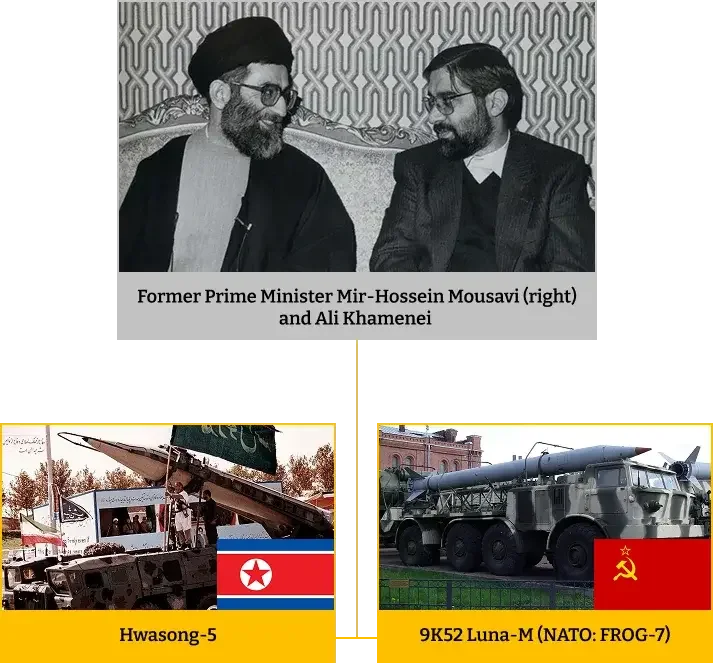
During the war, Iran captured a number of Soviet-made 9K52 Luna-M rockets from Iraq. The system was known in NATO terminology as the FROG-7. Those rockets later became one of the foundations for Iran’s Zelzal missile family.
Some IRGC members, including Tehrani Moghaddam, who later became leading commanders in the Guards’ missile program, were sent to Syria and Libya for training.
According to one account, widely repeated in official Iranian media, the Islamic Republic received around 30 Soviet Scud-B missiles from Libya in 1985 and 1986, during the rule of Muammar Gaddafi, then one of Tehran’s few willing military suppliers. Two of those missiles were not used in attacks on Iraq and later became the basis for the Shahab-1.
The reverse-engineering and production of the Shahab-1, however, were handled by Iran’s Defense Ministry, not the IRGC’s Self-Sufficiency Jihad Organization.
Another account says that in February 1986, the Islamic Republic, with Soviet approval, bought 30 Hwasong-5 missiles – North Korea’s version of the Scud-B – from Pyongyang. The purchase followed a loan from Tehran to North Korea for the production of the missiles.
Iran later bought production lines for the Hwasong-5 and Hwasong-6, or Scud-B and Scud-C, which became known in Iran as the Shahab-1 and Shahab-2. Those lines were placed under the Defense Ministry.
Within the Defense Ministry, Manouchehr Manteghi played a role in the missile program comparable to Tehrani Moghaddam’s role inside the IRGC.
During this period, Mousa Refan commanded the IRGC Air Force. He later became a senior manager at major engineering companies, including MAPNA, one of Iran’s largest power-plant and industrial engineering groups.
In effect, some of the IRGC figures who were initially active in the Defense Ministry’s missile work during the 1980s moved after the eight-year war into the Guards, where they pursued their missile projects through the IRGC’s Self-Sufficiency Jihad Organization.
Akbar Hashemi Rafsanjani
Akbar Hashemi Rafsanjani’s presidency, from 1989 to 1997, coincided with the creation of the IRGC Self-Sufficiency Jihad Organization. Rafsanjani, a central figure in the Islamic Republic’s postwar reconstruction, helped build the political and financial environment in which the missile program could expand.
During this period, the commanders of the IRGC Air Force were, in order, Hossein Dehghan and Mohammad Hossein Jalali.
Dehghan was also one of the founders of the Self-Sufficiency Jihad. He later became defense minister under Hassan Rouhani. Since October 2023, he has headed the Mostazafan Foundation, one of the Islamic Republic’s largest economic conglomerates, originally built on assets confiscated after the 1979 revolution. Dehghan is also internationally significant: the United States has sanctioned him and identified him as a former IRGC commander in Lebanon and Syria in 1983, the year of the Beirut Marine barracks bombing that killed 241 American service members.
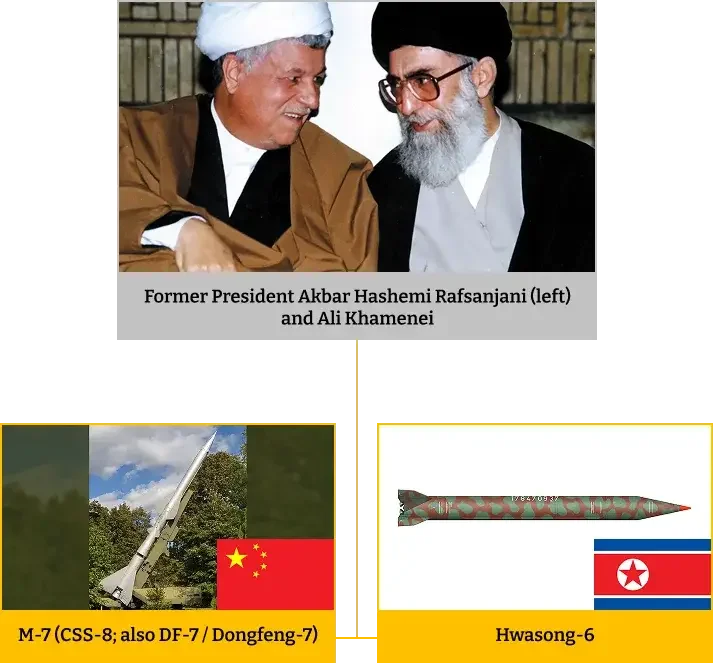
During Rafsanjani’s presidency, Iran purchased Hwasong-6 missiles from North Korea and M-7 missiles from China. The Hwasong-6 is a North Korean version of the Scud-C. The Chinese M-7 is also known as the CSS-8, and Iran later used the system under the name Tondar-69.
The M-7 missiles imported during this period became a basis for the Fateh missile family.
The only missile unveiled during this period was the Shahab-2, based on the Hwasong-6.
The most important missile-base project of this period was the start of construction at the western Isfahan missile base, also known as Ahmad Kazemi, near Najafabad, a city west of Isfahan in central Iran. Some initial development of underground facilities also took place during this period.
Mohammad Khatami
Mohammad Khatami, Iran’s reformist president from 1997 to 2005, became known abroad for promoting a “dialogue among civilizations.” Inside Iran’s military establishment, however, his presidency coincided with the command of Mohammad Bagher Ghalibaf and Ahmad Kazemi in the IRGC Air Force.
Just as Tehrani Moghaddam is considered the father of the Islamic Republic’s missiles, Ghalibaf can be seen as the central figure in building and expanding Iran’s missile bases. Ghalibaf later became Tehran’s mayor and then speaker of parliament and now Tehran’s top negotiator in US talks, but in the late 1990s he was an IRGC commander overseeing the air arm that would become central to Iran’s missile infrastructure.
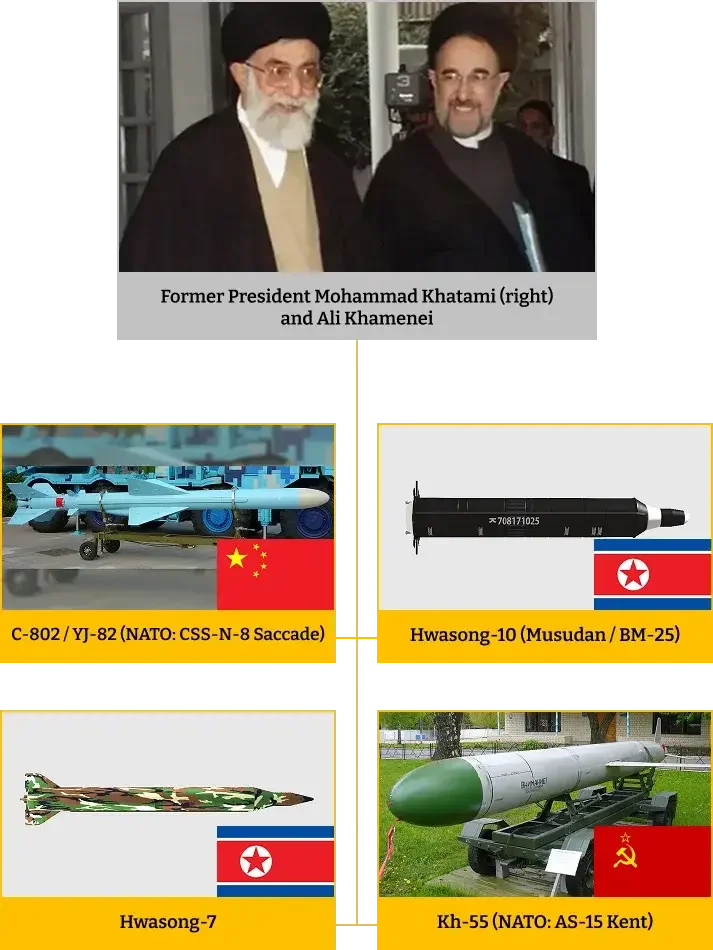
During Khatami’s presidency, Hwasong-7 missiles were imported from North Korea. The Hwasong-7, also widely known as the Nodong or No Dong, became the main basis for the Shahab-3 – the first Islamic Republic missile whose range could reach Israel.
During this same period, the Islamic Republic bought Soviet Kh-55 cruise missiles from Ukrainian arms dealers. The Kh-55, known by NATO as the AS-15 “Kent,” was originally designed as a long-range air-launched cruise missile. In Iran, it later became a basis for cruise-missile production designed to target Israel and US naval forces farther from Iran’s borders.
China’s C-802 anti-ship missile series was also purchased during this period. The system later became important to Iran’s anti-ship missile arsenal, including missiles designed to threaten naval traffic in the Persian Gulf and surrounding waters.
Under Khatami, Iran unveiled the Shahab-3 and Fateh-110 missiles.
In 2005 – spanning the final months of Khatami’s presidency and the start of Mahmoud Ahmadinejad’s – Iran purchased Hwasong-10 missiles from North Korea, according to Western assessments. The Hwasong-10, also known as the Musudan or BM-25, became the basis for Iran’s strategic Khorramshahr missile.
According to Amir-Ali Hajizadeh, the later commander of the IRGC Aerospace Force killed in June 2025 by an Israeli airstrike, and Ali Belali, another Aerospace Force commander, construction of underground missile depots – the so-called missile cities – outside central Iran began under Ghalibaf’s command in 1997, during Khatami’s presidency.
Mahmoud Ahmadinejad
Mahmoud Ahmadinejad, Iran’s hardline president from 2005 to 2013, took office as Tehran adopted a more confrontational posture over its nuclear and missile programs.
During his presidency, Mohammad-Reza Zahedi and Hossein Salami commanded the IRGC Air Force. Zahedi later became one of the IRGC’s most important regional commanders and was killed in an Israeli strike in Damascus in 2024. Salami later became commander-in-chief of the IRGC.
From 2009, after the force was renamed the IRGC Aerospace Force because of its expanding missile and space activities, Amir Ali Hajizadeh took command. Hajizadeh would remain one of the central figures in Iran’s missile program until he was killed in an Israeli strike in 2025.
No new missile was purchased during Ahmadinejad’s presidency.
Between 2005 and 2013, Iran unveiled the Noor, Qiam, Qader, Sejjil, Khalij Fars (or Persian Gulf), and Nasr missiles.
During this period, the IRGC’s missile cities expanded, but the main transformation was the entry of the IRGC Aerospace Force into space activities – a field closely tied to long-range missile technology because of its overlap in engines, guidance systems and launch infrastructure.
 Former President Mahmoud Ahmadinejad (right) and Ali Khamenei
Hassan Rouhani
Hassan Rouhani, Iran’s president from 2013 to 2021, came to office promising to ease the nuclear standoff with the West. Throughout his presidency, Hajizadeh commanded the IRGC Aerospace Force.
During this period, missile bases that had mostly been created under Khatami and during Ghalibaf’s command were expanded. New facilities were also established, especially in Iran’s southern cluster, closer to the Persian Gulf and the Strait of Hormuz.
The largest number of missile unveilings took place under Rouhani. But Farzin Nadimi, a senior fellow at the Washington Institute, argues that this was not necessarily because Rouhani gave special support to the missile program.
“It is said that Rouhani also had problems with the unruly missile program,” Nadimi said.
During this period, Iran unveiled the Kheibarshekan, Abu Mahdi, Haj Qassem, Khorramshahr-1 and Khorramshahr-2, Hormuz-1 and Hormuz-2, Raad-500, Fateh Mobin, Dezful, Hoveyzeh, Zolfaghar, Emad, Fateh-313, Ya-Ali, Soumar, Ghadir, and Nasr-e Basir missiles.
 Former President Hassan Rouhani (right) and Ali Khamenei
After Rouhani
From 2021 onward, during the presidency of Ebrahim Raisi, the hardline president who took office in 2021 and died in a helicopter crash in 2024, and then under Masoud Pezeshkian, the reformist politician elected president after Raisi’s death, some missile bases were expanded.
Iran also unveiled the Fattah-1 and Fattah-2, Qiam-2, Paveh, Etemad, Emad-2, Khorramshahr-4, Ababil and Ghadr-380 missiles.